A heat pump retrofit transforms your heating system to run on low-temperature water, typically 35°C to 55°C flow temperature. This approach delivers steady, even warmth and reduces direct fossil fuel use. In many homes, it opens a pathway to disconnecting gas entirely. The system works best when radiators are checked for adequate output at lower temperatures, a hot water cylinder is installed, and weather compensation controls are set up. Upfront costs are higher, but the Boiler Upgrade Scheme provides £7,500 off eligible installations in England and Wales, with a time-limited £9,000 uplift for off-gas-grid properties until 31 March 2027. VAT at zero rate applies until 31 March 2027, reverting to five percent thereafter. A well-designed retrofit can work in Victorian terraces, 1930s semis, and post-war housing when heat loss is calculated room by room and emitters are properly sized.
Retrofit and Boiler Replacement
Understanding Heat Pump Retrofit and Boiler Replacement
A heat pump retrofit can look daunting when your existing boiler is nearing the end of its life, especially in older Greater Manchester homes where radiators, pipework and insulation were designed around a hotter, faster blast of heat. The good news is that a well-designed retrofit can work reliably in a wide range of properties, including many Victorian and Edwardian terraces, 1930s semis, and post-war housing—provided the system is sized and set up for low-temperature heating rather than treated as a boiler swap.
The decision is rarely a simple heat pump or new boiler question. It is usually a sequence of choices about heat loss, emitter capacity, hot-water provision, controls, and practical constraints such as outdoor space and planning. When those pieces line up, a heat pump can deliver steady comfort and lower carbon heating; when they don't, homeowners can end up with rooms that never quite reach temperature, higher electricity use than expected, or an installation that has to be reworked.
If your main aim is a boiler replacement with minimal disruption, a like-for-like boiler swap is often the simplest route. UK pricing guides for 2026 typically put a like-for-like combi boiler replacement in the £2,500–£4,000 range, depending on the boiler and the job complexity. A heat pump retrofit usually has a higher upfront cost, but the gap can narrow sharply once grants and VAT treatment are factored in.
As of August 2026 in England and Wales, the Boiler Upgrade Scheme provides £7,500 off the cost and installation of eligible air-to-water, ground source and water source heat pumps. There is also a time-limited uplift to £9,000 for eligible off-gas-grid properties replacing oil or LPG, available from 21 July 2026 until 31 March 2027. In addition, a £2,500 grant is available for residential air-to-air heat pumps.
Key Retrofit Considerations
-
Start with a room-by-room heat-loss calculation, not the old boiler size
-
Low flow temperatures matter more than high kW marketing claims
-
A heat pump with existing radiators can work, but emitters must be checked
-
Hot water planning is essential when replacing a combi
-
Controls and commissioning are where comfort is won or lost
-
Grants and VAT rules can change the real cost more than expected
The Boiler to Heat Pump Transition
Many retrofit problems come down to one misconception: treating a heat pump like a boiler. Boilers are comfortable blasting high-temperature water through radiators for short periods; heat pumps are most comfortable supplying gentler heat for longer periods. That shift affects everything from radiator sizing to how thermostats and radiator valves are used.
Typical guidance for efficient operation often sits in the 35°C to 55°C flow temperature range for heating, rather than the higher temperatures commonly used with boilers. The key question homeowners ask is whether a heat pump with existing radiators will keep the house warm. It often can—but the answer is never yes by default.
Radiators are usually rated at a standard condition that assumes a much higher water temperature than a heat pump aims to run. Government research on radiator output at lower temperatures shows the reality starkly: at a 55°C flow temperature, radiators top out at about 63% of the original rated output in the scenario examined.
In plain terms, a radiator that felt fine on a boiler may be undersized once the system is run cooler, particularly in larger rooms, north-facing spaces, or draughtier parts of an older house. That does not automatically mean every radiator must be replaced.
The practical approach is to identify the weak rooms first: rooms that already struggle on cold days, rooms with single-skin walls or bay windows, and spaces where the radiator is small relative to the room. Sometimes a few larger radiators, a couple of fan-assisted convectors, or targeted insulation and draughtproofing can bring the whole system into a comfortable low-temperature range.
Heat pump retrofit old house projects also run into hot water constraints. If the current setup is a combi boiler, hot water is produced on demand—so there is typically no cylinder. A standard air-to-water heat pump usually needs a hot water cylinder, which creates a space and plumbing question.
A useful rule of thumb from mainstream UK guidance is that a cylinder can often fit in a cupboard with at least an 80cm x 80cm footprint, but layouts vary, and older properties sometimes have awkward airing-cupboard sizes or limited vertical clearance. In some homes, a cylinder goes where a pantry once was; in others, the best location is near the bathroom stack or in a utility area to reduce pipe runs and heat loss.
Practical Retrofit Stages
A calm way to think about retrofit is as a five-stage project, each stage reducing risk before money is committed to the next. Start with survey and heat-loss calculation: a room-by-room heat loss and a check of radiator outputs and pipework routes. Move to fabric and draught improvements: loft insulation, sealing obvious draught paths, and addressing uncontrolled ventilation where possible. Then tackle hydraulics and emitters: decide what to do with radiators, balancing valves, thermostatic radiator valves, and whether any pipework needs upgrading to support required flow rates. Address hot water and electrics: choose cylinder size and location, check incoming electrical supply capacity and routing, and plan condensate drainage and safe isolation. Finally complete commissioning and control: set weather compensation or similar load-following control, confirm flow temperatures, balance the system, and verify that each room reaches setpoint. Design the emitters and controls first, then choose the heat pump. That simple principle is one of the most reliable ways to avoid disappointment, because it pushes the project away from brand-led decisions and toward comfort-led decisions. There are genuine trade-offs to be clear about. Advantages of a properly designed heat pump retrofit include steady, even warmth; reduced direct fossil fuel use; and, in many homes, a pathway to disconnecting gas entirely. Heat pumps can also pair well with other upgrades over time. The disadvantages are equally real: higher upfront cost; the need for a hot water cylinder when replacing a combi; potential radiator upgrades; and sensitivity to design and commissioning quality. Noise and placement can also matter, particularly in densely built-up streets where the outdoor unit must be positioned thoughtfully.
Planning and Installation
Permits and Layout
Understanding Planning Requirements
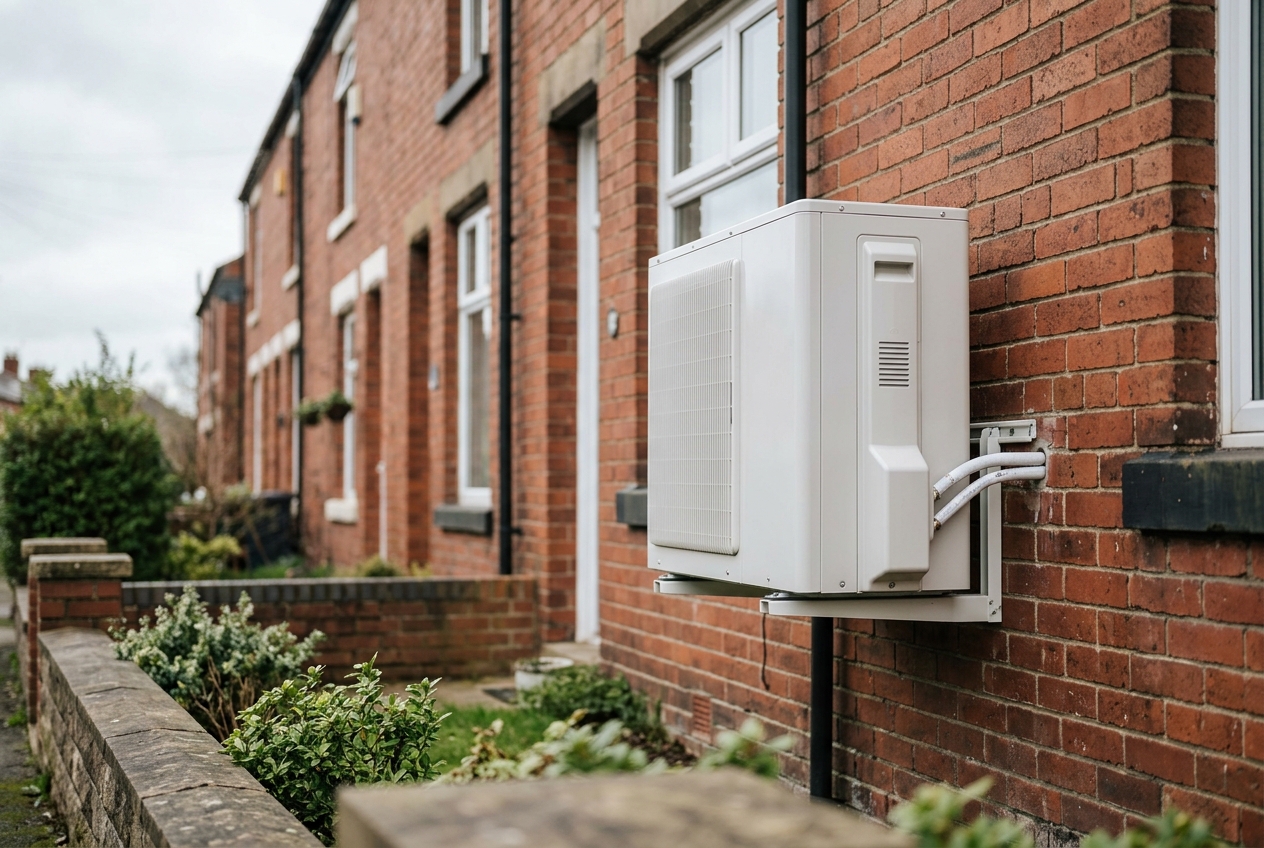
Planning is often simpler than people fear, but it cannot be assumed. In England, installing an air source heat pump is commonly permitted development if it meets the relevant limits and conditions, including compliance with the Microgeneration Certification Scheme planning standard for noise assessment (MCS 020a). From 28 May 2026, MCS 020a is the only permitted certification scheme referenced for this purpose. Listed buildings, many conservation areas, and some flats with leasehold constraints can be different—so it's sensible to confirm early if any formal consent is required.
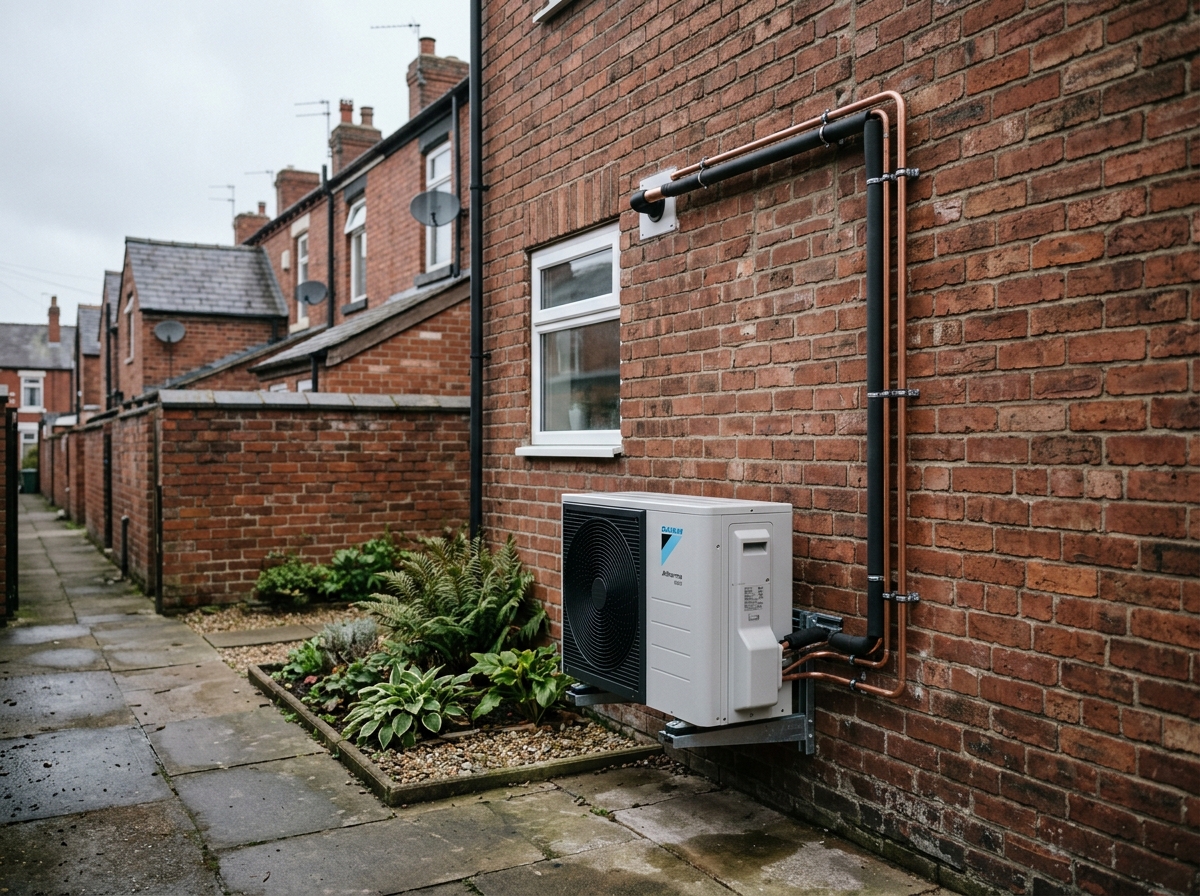
A typical rear-of-terrace installation needs tidy routing and vibration isolation when neighbours are close
Homeowner Retrofit Checklist
A straightforward homeowner checklist can prevent the most common retrofit surprises before any installation date is booked. Confirm these details with your installer early in the process.
- Confirm the heat-loss calculation is room by room
- Ask what flow temperature the design targets in winter
- Check which radiators are flagged for upgrade
- Confirm the hot water cylinder size and location
- Ask how the system will be controlled day to day
- Verify grant eligibility and installer certification early
Comparing Your Options
Understanding the real differences between heat pump retrofit and boiler replacement helps you make an informed decision for your Greater Manchester home.
New Boiler
A like-for-like combi boiler replacement is often the simplest route for minimal disruption. UK pricing guides for 2026 typically put this in the £2,500–£4,000 range, depending on the boiler and job complexity. The installation is familiar to most heating engineers, requires no cylinder space, and keeps the existing radiators and controls largely unchanged. Boilers are comfortable blasting high-temperature water through radiators for short periods, so rooms warm quickly. However, a new boiler does not reduce direct fossil fuel use, does not qualify for the Boiler Upgrade Scheme, and does not open a pathway to disconnecting gas. If the property has severe fabric issues that cannot yet be addressed, if there is no feasible cylinder space, or if the homeowner needs the absolute lowest upfront spend today, a new boiler may be the pragmatic interim step.
Installation Costs
Costs vary by heat loss, cylinder work, radiator upgrades, and job complexity
Five Practical Retrofit Stages
- Survey and heat-loss calculation with radiator output check
- Fabric and draught improvements including loft insulation
- Hydraulics and emitters including radiator and pipework upgrades
- Hot water and electrics with cylinder sizing and supply check
- Commissioning and control including weather compensation setup
Retrofits Succeed When Expectations Match Reality
The most reassuring takeaway is that retrofits succeed when expectations match how heat pumps actually work. A heat pump does not need to feel like a boiler to be comfortable; it needs a system designed around low-temperature delivery, adequate radiator output, and stable control.