Skip to content

Heat Pump Costs and Running Expenses

N Northline Heat Pumps
11 min read

Understanding Heat Pump Investment and Operation

Heat pump costs in Greater Manchester split across survey and design, equipment, system modifications—radiators, hot-water cylinders—and day-to-day electricity use. An air-to-water system extracts ambient heat and upgrades it via refrigeration so it can warm water for radiators or underfloor heating and supply hot water for taps and showers. That design shift away from a boiler changes what you pay for and how you use heat: a boiler delivers very hot water quickly; a heat pump is most economical when it runs steadily at lower flow temperatures.

For most Manchester homes the Energy Saving Trust describes typical installation costs around twelve thousand pounds. That installed figure bundles the outdoor unit, controls, hot water cylinder if you currently have a combi boiler, pipework changes, system flushing, commissioning, and compliance paperwork. Depending on the home there may also be radiator upgrades so the house can be heated comfortably at lower water temperatures. The real price is easiest to understand when broken into what you are actually paying for.

The Boiler Upgrade Scheme materially changes the up-front maths in England and Wales. As of August 2026 the scheme provides seven thousand five hundred pounds off air-to-water heat pump installations, two thousand five hundred pounds off air-to-air heat pumps for residential properties, and five thousand pounds off biomass boilers. There is also an uplifted nine thousand pound grant for air-to-water or ground source heat pumps in eligible off-gas-grid properties from 21 July 2026 until 31 March 2027. That grant is taken off the installation invoice when you use an MCS-certified installer.

Running expenses depend on two numbers: the price per kilowatt-hour of electricity and the amount of electricity the heat pump needs to deliver each kilowatt-hour of heat. Seasonal performance—often given as SCOP—is the average efficiency over a heating season including colder weather. A SCOP of 2.8 means the heat pump delivers about 2.8 kilowatt-hours of heat for every one kilowatt-hour of electricity consumed. Under the 1 July to 30 September 2026 price cap electricity stands at 26.11 pence per kilowatt-hour with a 57.19 pence per day standing charge and gas at 7.33 pence per kilowatt-hour with 29.04 pence daily standing charge.

Six Practical Takeaways

  • Use a proper heat-loss assessment to avoid oversizing and inflated running costs

  • Expect most of the budget in installation and system changes not the outdoor unit alone

  • In England and Wales the Boiler Upgrade Scheme can reduce up-front cost by £7,500

  • Eligible off-gas-grid homes can get £9,000 from 21 July 2026 to 31 March 2027

  • Heat pump running costs depend mainly on efficiency SCOP and electricity unit rates

  • Annual servicing is usually £150–£300 and protects performance and warranties

What Drives Up-Front Investment

The Energy Saving Trust describes typical installation costs for an air source heat pump as around twelve thousand pounds. In real quotes that installed figure usually bundles multiple elements: the outdoor unit, new controls, a hot water cylinder if you currently have a combi boiler, pipework changes, system flushing, commissioning, and the paperwork and testing that should come with a compliant install.

Depending on the home there may also be upgrades to radiators or extra radiators so the house can be heated comfortably at lower water temperatures. A useful way to think about cost is to separate the heat pump from the heating system that makes the heat pump work well. In older Greater Manchester housing stock—Victorian terraces, nineteen-thirties semis, post-war builds—the system side can dominate: radiator sizing, pipework layout, control strategy, and balancing.

A heat pump can be efficient on paper and still be expensive to run if it is forced to operate at unnecessarily high flow temperatures because emitters are undersized, the building loses heat quickly, or controls are set up like a boiler with short on-off bursts. When people are unhappy with bills the root cause is often a system design problem rather than the technology itself.

For domestic installations heat pumps fall under the temporary zero per cent VAT relief for energy-saving materials in place until 31 March 2027. That does not remove the need to budget carefully but it does mean the invoice structure can be different from a boiler replacement especially if your project includes preparatory work that is necessary for the installation.

The Boiler Upgrade Scheme materially changes the up-front maths. As of August 2026 the scheme provides seven thousand five hundred pounds off the cost and installation of air-to-water heat pumps and ground source and water source heat pumps, two thousand five hundred pounds off air-to-air heat pumps for residential properties, and five thousand pounds off biomass boilers.

In other words if your starting air source heat pump cost is close to the twelve thousand pound typical figure the grant can turn a daunting headline price into a much more manageable out-of-pocket figure—provided the design is right and the quote includes everything you will need for comfortable low-temperature heating.

Baseline Costs August 2026

Typical installation Equipment, cylinder, pipework, commissioning, compliance ~£12,000
BUS grant (air-to-water) Standard grant England and Wales −£7,500
BUS off-gas uplift Eligible homes 21 July 2026 to 31 March 2027 −£9,000
Annual servicing Pressure, filters, drainage, controls, performance checks £150–£300
Electricity unit rate Ofgem price cap 1 July to 30 September 2026 26.11p/kWh
Gas unit rate Ofgem price cap same period 7.33p/kWh

Figures based on Energy Saving Trust and Ofgem cap for July to September 2026. Actual costs vary with property and system design.

Maintenance and Long-Term Performance

Annual servicing protects efficiency and catches performance drift before it shows up as mysteriously high bills

How Efficiency and Pricing Work Together

Running expenses are driven by the price you pay per kilowatt-hour of electricity and the amount of electricity the heat pump needs to deliver each kilowatt-hour of heat. Installers and manufacturers may talk about COP—coefficient of performance—in a specific test condition but for household budgeting seasonal performance matters more. That is often given as SCOP, the seasonal COP: the average efficiency over a heating season including colder weather. In plain language a SCOP of 2. 8 means that over the season the heat pump delivers about 2. 8 kilowatt-hours of heat for every one kilowatt-hour of electricity it consumes. Under the Ofgem energy price cap for 1 July to 30 September 2026 average direct-debit unit rates stand at 26. 11 pence per kilowatt-hour for electricity and 7. 33 pence per kilowatt-hour for gas with average standing charges of 57. 19 pence per day for electricity and 29. 04 pence per day for gas. Those cap figures allow a simple cost-per-unit-of-heat sense-check. At 26. 8 each kilowatt-hour of delivered heat works out at about 9. 3 pence. For gas if a boiler averages ninety per cent efficiency in real use a 7. 1 pence per kilowatt-hour of delivered heat. That gap is why some homes on standard price-cap rates find a heat pump's space-heating costs broadly similar to gas or slightly higher while others still save—especially if the boiler being replaced is old, poorly controlled, or the home can make good use of lower-cost electricity periods. Heat pumps reward steady low-temperature operation. Weather compensation—where the heat pump automatically adjusts flow temperature based on outdoor temperature—and longer run times can sound counter-intuitive if you are used to a boiler that blasts heat for a couple of hours. But a heat pump's efficiency falls as flow temperature rises so asking it to make very hot water for radiators can push electricity use up quickly. This is also why radiator upgrades are sometimes essential: bigger radiators can deliver the same room heat at a lower flow temperature keeping efficiency—and comfort—where it should be.

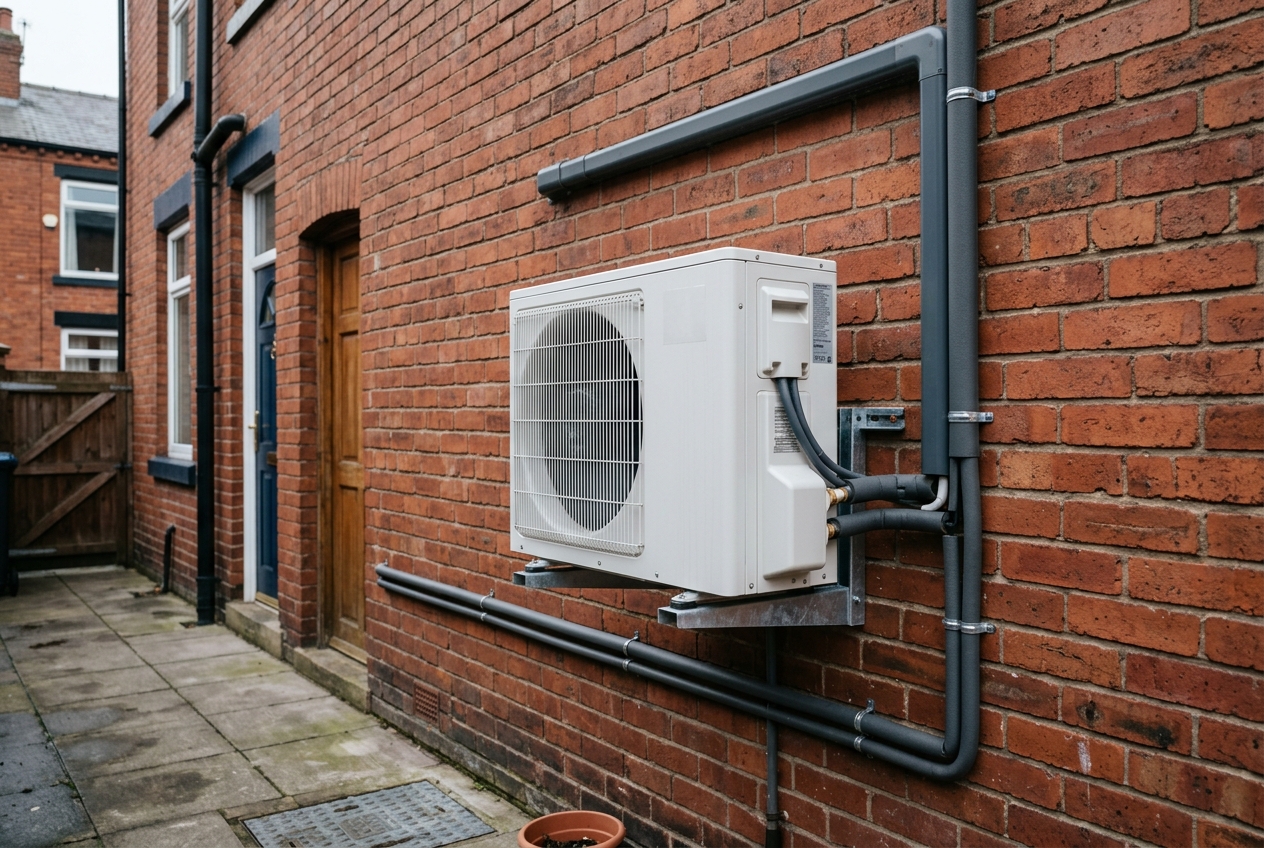
Air source heat pump outdoor unit on brick wall
Outdoor heat pump unit mounted on external wall of Manchester terrace home

Three Angles to Judge Value

These three perspectives help homeowners understand running expenses without being overwhelmed by jargon or falling into common misconceptions about heat pump operation.

Fabric and Emitters

Insulation, draught control, and radiator or underfloor output determine what flow temperature you will need on the coldest days. That sets the ceiling on efficiency. Bigger radiators can deliver the same room heat at a lower flow temperature keeping the heat pump's coefficient of performance high and electricity consumption down. In older Greater Manchester housing stock—Victorian terraces, nineteen-thirties semis, post-war builds—radiator sizing and pipework layout often dominate the system side of the budget. A heat pump forced to operate at unnecessarily high flow temperatures because emitters are undersized or the building loses heat quickly will be expensive to run regardless of the outdoor unit's rated performance. The fabric determines the base demand; the emitters determine the temperature the system must reach to meet that demand.

Controls and Habits

Consistent setpoints, zoning that matches how you live, and correct hot-water scheduling prevent the system from wasting electricity chasing temperature swings. A heat pump is most economical when it runs steadily at lower flow temperatures keeping the house gently topped up rather than delivering very hot water in short bursts like a boiler. Treating the heat pump like a combi boiler with high setpoints, short schedules, and aggressive setbacks can all increase electricity use because the system is repeatedly asked to catch up at higher power. Early-season optimisation after you have lived with the system for a few weeks often delivers the biggest comfort win through small control tweaks.

Pricing and Flexibility

If your household can shift hot-water heating and some space heating into cheaper periods—using the cylinder and the building's thermal mass as storage—running expenses can be materially lower than the headline unit rate suggests. At 26.11 pence per kilowatt-hour standard electricity and a SCOP of 2.8 delivered heat costs about 9.3 pence per kilowatt-hour. For gas at ninety per cent boiler efficiency and 7.33 pence per kilowatt-hour that is roughly 8.1 pence per kilowatt-hour of heat. The gap narrows or reverses when you factor in standing charges—disconnecting from gas saves about one hundred and six pounds per year at price-cap rates—and when you access lower-cost off-peak electricity periods. Heat pumps can reduce exposure to gas price swings and in all-electric homes they remove the gas standing charge altogether.

Service Costs and What They Protect

Maintenance is a smaller line item than electricity but it has an outsized impact on long-term cost because it protects efficiency. As of July 2026 OVO states that air source heat pump service costs typically range from one hundred and fifty to three hundred pounds for a standard annual visit.

That service is not just box-ticking: it should include checks on system pressure, filters and strainers, condensate drainage, temperatures and flow rates, controls, and overall operation. Skipping maintenance can lead to subtle performance drift—higher flow temperatures than necessary, cycling on and off, or poor hot-water recovery—that shows up later as mysteriously high electricity use.

A sensible budgeting process for a Manchester retrofit can be thought of in six stages each one reducing risk. Home survey and heat-loss calculation with clear assumptions about insulation and ventilation. System design: heat-pump sizing, emitter plan for radiators or underfloor, cylinder sizing, and control strategy. Pre-installation work including any radiator changes, pipework corrections, insulation improvements, and electrical checks.

Installation and commissioning including setting weather compensation and hot-water temperatures. Early-season optimisation with small control tweaks once you have lived with the system—often the biggest comfort win. Annual service and ongoing checks to keep performance stable over the years.

There are also recurring mistakes that inflate heat pump costs over the life of the system. Oversizing is a major one: bigger is not safer if it forces short cycling and higher temperatures. Another is treating the heat pump like a combi boiler with high setpoints, short schedules, and aggressive setbacks which can all increase electricity use because the system is repeatedly asked to catch up at higher power.

A third is ignoring the hot-water cylinder: cylinder size, reheat schedule, and the use of a periodic high-temperature cycle where appropriate all affect both comfort and consumption. Understanding what drives each piece is the quickest way to avoid overpaying up front and being disappointed by running expenses later.

Real-World Performance Depends on Design

When the System is Surveyed Right

System Integration

When the System is Surveyed Right

Heat pumps can provide very even comfort particularly in homes that previously ran a boiler for short bursts and struggled with cold rooms. They can reduce exposure to gas price swings and in all-electric homes they can remove the gas standing charge altogether. With Boiler Upgrade Scheme support—seven thousand five hundred pounds for air-to-water and two thousand five hundred pounds for air-to-air in residential properties as of August 2026 plus the time-limited nine thousand pound off-gas-grid uplift from 21 July 2026 to 31 March 2027—many households find that the hardest part is no longer can I afford the technology but can I get a design that will run efficiently in my specific house.

Running costs are the predictable result of heat demand, flow temperature, and unit rates—not mystery behaviour

Drawbacks to Consider Before You Commit

  • Up front usually more expensive than boiler replacement even after grants if home needs multiple radiators
  • Space constraint: outdoor unit needs adequate airflow and indoor location for cylinder if absent
  • Noise and neighbour considerations especially in terraces where boundary distances are tight
  • Siting and mounting details can make difference between barely noticeable and annoying
  • Running-cost advantage not automatic on standard electricity pricing if system poorly designed
  • System forced to run hot or with short cycling can push electricity use up quickly
August 2026 Baseline

Numbers You Can Anchor a Decision On

Typical air source heat pump installation around twelve thousand pounds. Boiler Upgrade Scheme support of seven thousand five hundred pounds for air-to-water or nine thousand pounds for eligible off-gas-grid homes within the uplift window. Annual servicing commonly one hundred and fifty to three hundred pounds. Under the 1 July to 30 September 2026 price cap electricity at 26.11 pence per kilowatt-hour and gas at 7.33 pence per kilowatt-hour.